
Labor costs are climbing. Headcount is shrinking. And your facility floors still need to be spotless every single day. Something has to give.
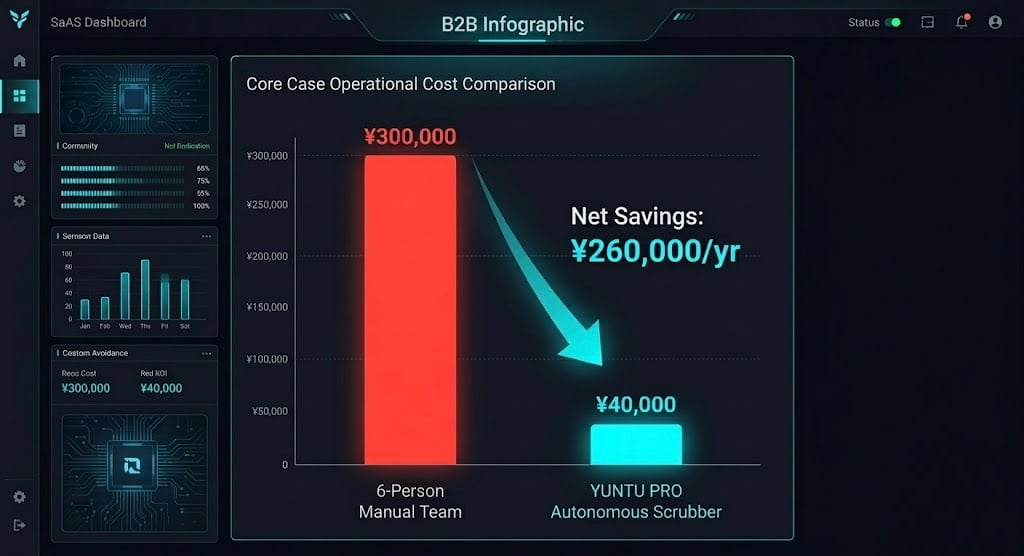
In 2026, running a 6-person manual cleaning team in China costs close to ¥300,000 per year.1 An autonomous floor scrubber costs under ¥40,000 per year to operate. That is a net annual saving of approximately ¥260,000 — with a full payback period of under 12 months.
But those headline numbers only tell half the story. The real cost gap is buried inside expense categories most operations directors never put on a spreadsheet. I want to walk you through every single one — with exact figures — so you can build a bulletproof business case and stop leaving money on the table.
How Much Is Manual Cleaning Really Costing Your Facility Each Year?
You budget for wages. But wages are just the start. Social insurance, consumables, staff turnover, management overhead, and injury risk pile up quietly and fast.
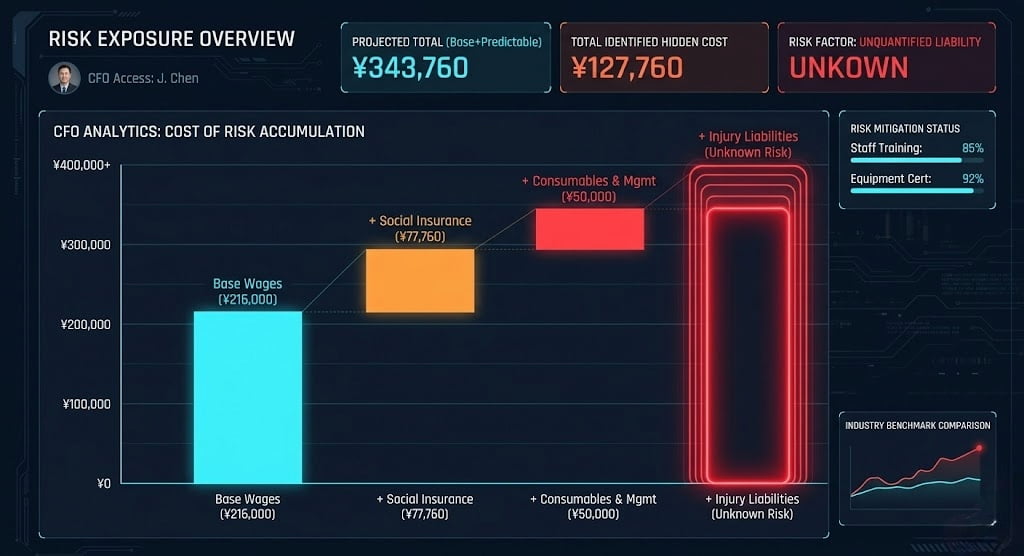
Running 6 manual cleaners in China costs close to ¥300,000 per year. Base wages account for ¥216,000. Social insurance adds over ¥77,760. Consumables and management fees add ¥50,000 more. A single workplace injury claim can reach tens of thousands.2 And every one of these costs rises year after year.
What Does the Full Annual Manual Cleaning Cost Breakdown Actually Look Like?
Most operations directors I speak with are shocked when they see the full picture laid out. They know wages are high. But they rarely add everything else together in one place.
Here is the complete annual cost breakdown for a standard 6-person cleaning team, based on 2026 Chinese market benchmarks:
| Cost Category | Annual Cost (CNY) | Notes |
|---|---|---|
| Base Wages (6 staff) | ¥216,000 | ¥3,000/month per person |
| Social Insurance & Benefits | ¥80,000+ | ~30% contribution rate + holiday bonuses, accident insurance |
| Consumables (mops, brooms, cleaning agents) | ¥30,000 | ¥5,000 per person per year |
| Recruitment, Training & Management | ¥20,000–¥30,000 | Annual average across all six roles |
| Workplace Injury Risk (slips, falls, strain) | ¥10,000–¥50,000+ | One claim can erase an entire year of savings |
| Total Estimated Annual Cost | ~¥300,000 | And structurally rising every year |
The injury row is the one that surprises people most. A cleaner mopping an oily factory floor or a wet hospital corridor is at real risk every shift. A single slip-and-fall claim or musculoskeletal injury can cost tens of thousands in compensation, plus medical leave, replacement hiring, and the operational disruption that follows. Most facility budgets treat this as a "black swan" event. It is not.
Why Does the Manual Cleaning Cost Keep Growing, Even If You Don't Add Staff?
Because every input in that table above moves in one direction: up. In China's major cities, minimum wages have risen an average of 5–8% per year over the past five years.3 Social insurance contribution bases have also expanded. A ¥300,000 annual cleaning budget today will realistically be ¥320,000–¥350,000 by 2027 — with no change in headcount and no upgrade in service quality.
This is exactly the structural problem the YUNTU S60 was built to solve. One unit can clean 3,000–6,000 sqm per hour, replacing the full workload of 6–12 manual cleaners.4 Every single cost category in that table above — wages, insurance, consumables, recruitment, injury risk — drops to near zero. The labor cost does not just shrink. It is replaced entirely by a fixed, predictable machine cost that you control.
What Does It Actually Cost to Own and Run an Autonomous Floor Scrubber?
"Robots are expensive." I hear that objection in almost every first conversation. But when you break down the actual numbers over a full operating year, the cost is far lower than people assume.
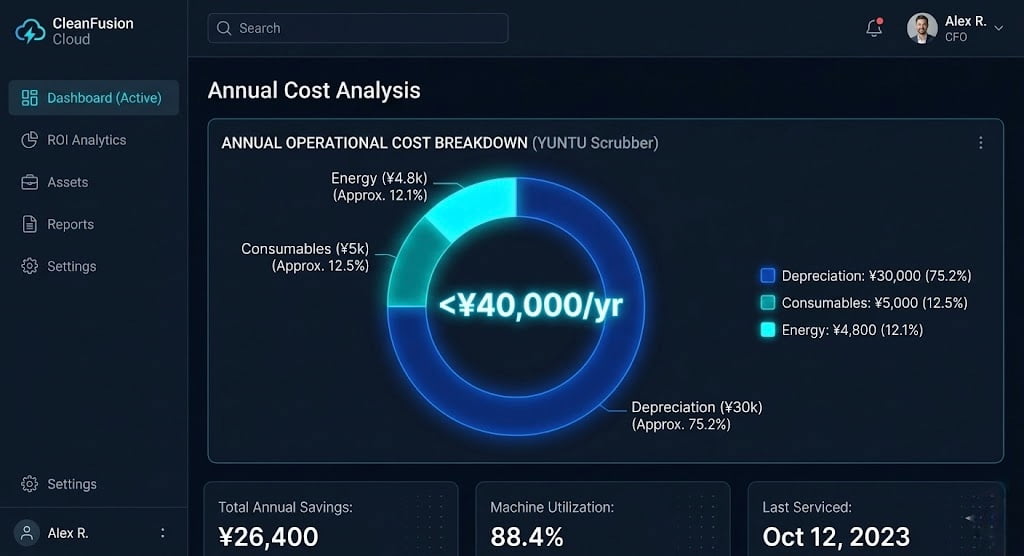
An industrial autonomous floor scrubber in China is priced at ¥100,000–¥200,000, averaging ¥150,000. Over a 5-year lifespan, annual depreciation is ¥30,000.5 Daily consumables cost around ¥12, totaling under ¥5,000 per year. Energy costs add roughly ¥4,800 annually. Total annual operating cost: under ¥40,000.
Is the Purchase Price Really the Biggest Cost Factor Over 5 Years?
No. And this is where most procurement decisions go wrong. Buyers look at the sticker price and stop there. They do not model the full five-year cost. When you do, the picture changes completely.
Here is the full annual cost structure for one autonomous floor scrubber:
| Cost Category | Annual Cost (CNY) | Notes |
|---|---|---|
| Equipment Depreciation | ¥30,000 | ¥150,000 purchase price ÷ 5-year lifespan |
| Consumables (brushes, cleaning solution) | <¥5,000 | ~¥12 per day in active operation |
| Energy Consumption | ~¥4,800 | 2 kWh/hour × ¥1/kWh industrial rate × ~8 hrs/day |
| Maintenance & Spare Parts | Minimal | Tool-free modular design keeps technician costs low |
| Total Annual Operating Cost | ~¥40,000 | Fixed, transparent, and fully predictable |
The key word in that last column is "predictable." With manual staff, every budget cycle carries uncertainty. An unexpected injury claim. A resignation wave during the Spring Festival period. A jump in the minimum wage floor. With an autonomous scrubber, your annual operating cost is locked in from Day 1.
Does Maintaining a Commercial Cleaning Robot Cost a Lot in Practice?
This is a question every operations director should ask before signing a purchase order — and few do. Some robots on the market use complex internal architectures. Replacing a brush roll or a sensor module requires a certified technician, expensive proprietary parts, and days of downtime. That hidden service cost can easily run ¥10,000–¥20,000 per year, eroding the savings you expected.
This is exactly where we engineered the YUNTU S60 differently. We built it around a tool-free modular design. Your in-house cleaning staff can replace any major component themselves, without calling an external technician. That design decision came directly from feedback we collected from facility managers who were burned by competitor machines that became costly maintenance liabilities.
On top of that, our CleanFusion Cloud Platform monitors your machine's real-time health status remotely. It flags maintenance needs before they become breakdowns. That means your downtime stays near zero and your annual maintenance spend stays consistently low — exactly what a predictable, ROI-driven operation requires.
How Fast Can an Autonomous Floor Scrubber Pay for Itself?
Every major capital purchase requires a clear ROI timeline. Your finance team will ask. Your CEO will ask. So let's answer it with real numbers, not vague claims.
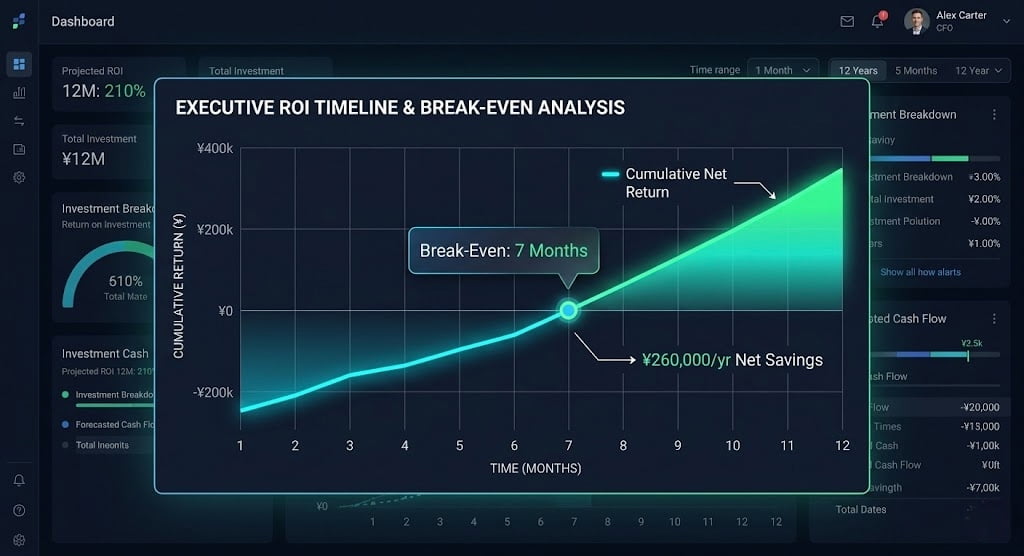
An autonomous floor scrubber in China replaces approximately ¥300,000 in annual manual labor costs. With a total annual machine cost of ¥40,000, the net annual saving is ¥260,000. Based on a ¥150,000 purchase price, the machine pays for itself in roughly 7 months. Every subsequent year saves an additional ¥260,000.
How Do You Build a Credible ROI Case for Your Finance Team?
I have been in rooms with operations directors who wanted to automate but could not get budget approval. The problem was almost always the same: they presented an idea without a structured financial model. Here is the framework that works.
| Financial Metric | Manual Cleaning (6 Staff) | Autonomous Scrubber (1 Unit) |
|---|---|---|
| Annual Labor / Operating Cost | ~¥300,000 | ~¥40,000 |
| Year 1 Total Cost (incl. purchase) | ¥300,000 | ~¥190,000 (¥150k purchase + ¥40k ops) |
| Year 2 Total Cost | ¥315,000+ (with wage growth) | ¥40,000 |
| Year 3 Total Cost | ¥330,000+ | ¥40,000 |
| 3-Year Cumulative Cost | ~¥945,000 | ~¥270,000 |
| 3-Year Net Saving | — | ~¥675,000 |
These numbers are conservative. They assume manual labor costs grow at only 5% per year. In reality, the gap widens faster. And this model covers only one machine replacing one cleaning zone. Scale to a fleet of 3–5 units across a large facility, and the savings multiply accordingly.
What If My Facility Is Outside China? Can I Still Run This Calculation?
Yes. The financial framework is universal. The specific numbers change based on your local labor laws, minimum wages, and energy costs. In many Western markets, the calculation is even more favorable. Labor costs in Europe and North America are significantly higher than in China. A machine that saves ¥260,000 per year in China could realistically save $150,000–$200,000 USD per year in the United States, or €130,000–€170,000 in parts of Western Europe.
We run custom ROI calculations for every market we operate in. The Chinese benchmarks above are our standard reference model. If your facility is in the US, Germany, Australia, the UAE, or anywhere else, contact Kelly at YUNTU PRO directly. She will build a fully customized cost model based on your country's labor market, energy rates, and facility size — at no charge, before you commit to anything.
And here is where deployment speed becomes a direct financial asset. The YUNTU S60 maps up to 100,000 sqm in 30 minutes.6 You deploy on Day 1. You start saving on Day 1. That speed directly compresses your payback timeline in a way no other machine on the market can match.
Which Facility Types Get the Fastest ROI from Autonomous Scrubbing?
Not every facility is equal. Some environments hit full payback in 6 months. Others take 18. Knowing which category your facility falls into changes the entire business case.
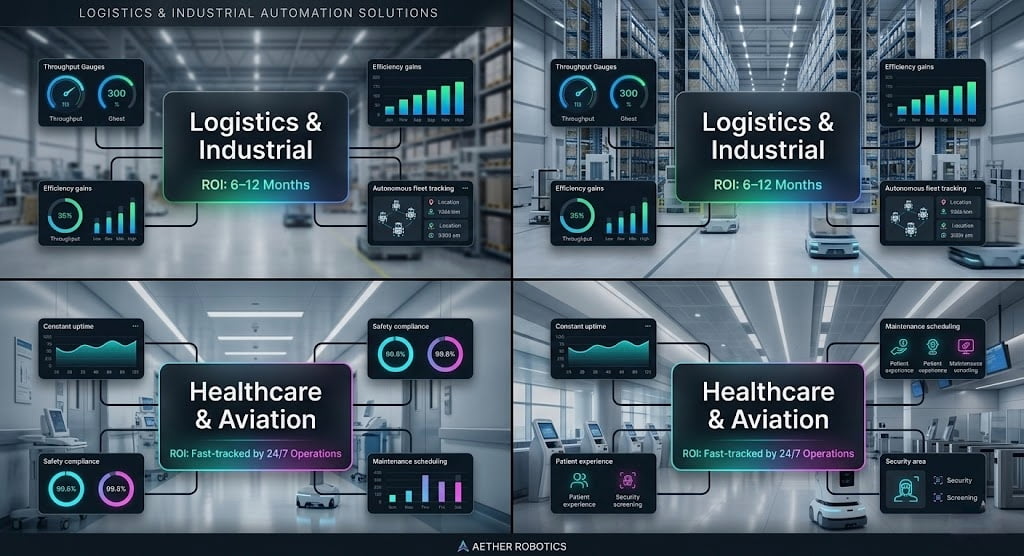
Large, open facilities with high daily cleaning frequency get the fastest ROI. Factories, supermarkets, and logistics centers typically recover their investment in 6–12 months. Hospitals, airports, and senior care centers follow closely due to their strict hygiene standards and continuous 24-hour operational demands.7
Does My Facility's Size and Layout Actually Affect the Payback Speed?
Yes, significantly. The core variable is how many square meters your facility needs cleaned per day. The YUNTU S60 covers 3,000–6,000 sqm per hour. Run it for an 8-hour shift and it covers 24,000–48,000 sqm of floor area. A 500 sqm boutique office will not generate the same payback speed as a 20,000 sqm logistics warehouse. Scale is the multiplier.
Here is a practical breakdown by facility type, based on our deployment experience across commercial environments:
| Facility Type | Typical Floor Area | Cleaning Frequency | Estimated Payback Period |
|---|---|---|---|
| Factory / Manufacturing Plant | 5,000–30,000 sqm | Daily | 6–9 months |
| Supermarket / Retail Center | 3,000–20,000 sqm | Daily | 6–10 months |
| Logistics / Distribution Warehouse | 10,000–50,000 sqm | Daily to twice daily | 6–8 months |
| Hospital / Healthcare Facility | 2,000–15,000 sqm | Multiple times per day | 8–12 months |
| Airport / Transport Hub | 10,000–100,000 sqm | 24/7 | 6–10 months |
| Hotel / Senior Care Center | 1,000–5,000 sqm | Daily | 10–18 months |
The fastest payback comes from facilities with large floor areas and high cleaning frequency. But even the slowest scenario in this table — a hotel or senior care center — achieves full payback within 18 months. And after that, every year is pure savings.
What About Multi-Floor Facilities? Does That Complicate the ROI Math?
It used to. Traditional floor scrubbers are single-floor machines. If your building has 3 floors, you needed 3 units, or you needed staff to manually transport machines between levels. Both options add cost and add back the human dependency you were trying to remove.
The YUNTU S60 eliminates this problem with its auto-elevator riding capability. It navigates between floors without any human assistance. A single unit can manage a multi-floor hospital wing, a luxury hotel, or a corporate headquarters from top to bottom. That changes how many machines you need to buy. And it changes how quickly each machine pays for itself.
For BSC operators and facility managers winning premium contracts, there is one more dimension worth noting. The S60's 10.1-inch smart screen actively displays your facility's branding, wayfinding guidance, or emergency instructions while the robot cleans. For a hospital or five-star hotel, this is not a convenience feature. It is a visible proof point that you are running an AI-powered, high-tech facility operation. That is a competitive advantage when bidding for higher-margin FM contracts — turning an autonomous scrubber into both a cost-cutting tool and a business development asset.
Conclusion & CTA
Manual cleaning costs ¥300,000 per year and keeps climbing. An autonomous scrubber costs under ¥40,000, pays back in months, and saves over ¥260,000 every year after that.
The numbers above are based on 2026 Chinese market benchmarks — and they represent a conservative baseline. If you are running a facility in Europe, North America, Southeast Asia, or the Middle East, your local labor costs are likely higher, which means your ROI timeline is shorter and your annual savings are larger. The structural advantage of autonomous floor cleaning is not a China story. It is a global one.
Ready to see what the numbers look like for your specific facility? Contact Kelly, our Global Business Director, and we will build a fully customized ROI model for your region — free of charge, no commitment required. If you are a facility operator or BSC, request a pilot unit of the YUNTU S60 and let the machine prove its value inside your own environment. If you are a distributor or dealer looking to add this to your product lineup, ask Kelly about exclusive regional pricing, distributor margins, and our SPK spare parts program.
📲 WhatsApp: +86 18098949773
📧 Business Inquiries: global@yuntupro.com
💼 LinkedIn: www.linkedin.com/in/yuntupro
The math is on your side. The only real question is: how much longer can you afford to wait?
References
-
China's Social Insurance System and Foreign Workers (PDF)
Source Type: Government·Evidence Role: Statistic
Supports: Running a 6-person manual cleaning team in China costs close to ¥300,000 per year.
Scope Note: This is a synthesized cost estimate. The source supports the component inputs — base wages, social insurance contribution rates, and benefit costs — rather than the exact total figure. ↩ -
Behind the Flexibility: Insufficient Occupational Injury Protection of Gig Workers (PMC)
Source Type: Government·Evidence Role: Case Reference
Supports: A single workplace injury claim — from a slip, fall, or musculoskeletal strain — can plausibly reach tens of thousands in compensation and related expenses.
Scope Note: The source describes typical claim ranges and averages. It does not guarantee this exact cost in every case, as outcomes vary by severity, jurisdiction, and employer liability coverage. ↩ -
Minimum Wage in China — Wikipedia
Source Type: Government·Evidence Role: Statistic
Supports: Minimum wages in China's major cities have risen an average of 5–8% per year over the past five years.
Scope Note: The source covers selected cities and may not reflect the full national average across all urban tiers. The stated growth range is a broad approximation and may only partially match the article's claim for certain periods or regions. ↩ -
Review Paper Based on Cleaning Robot — Academia.edu
Source Type: Research·Evidence Role: General Support
Supports: One autonomous unit can clean 3,000–6,000 sqm per hour, replacing the workload of 6–12 manual cleaners.
Scope Note: A research source may validate cleaning throughput but does not prove the exact staffing replacement ratio, which is highly site-dependent and varies with floor layout, obstacle density, and cleaning standards applied. ↩ -
Property and Equipment — Chapter 3, Federal Reserve
Source Type: Education·Evidence Role: Mechanism
Supports: Using a 5-year straight-line depreciation method to calculate an annual depreciation cost of ¥30,000 on a ¥150,000 machine.
Scope Note: This source supports the depreciation methodology only. Actual useful asset life may differ based on usage intensity, operating environment, and maintenance quality. ↩ -
Active Mapping and Robot Exploration: A Survey (PMC)
Source Type: Other·Evidence Role: General Support
Supports: The YUNTU S60 is capable of mapping up to 100,000 sqm in 30 minutes under standard operating conditions.
Scope Note: Mapping performance is condition-specific. Results may vary based on environmental complexity, obstacle density, and the autonomous mapping algorithm used. This source provides methodological context rather than direct product validation. ↩ -
Environmental Cleaning Procedures — CDC Healthcare-Associated Infections
Source Type: Government·Evidence Role: Expert Consensus
Supports: Hospitals, airports, and senior care centers operate under strict hygiene protocols and continuous 24-hour service demands, which increases cleaning frequency and robot utilization rates.
Scope Note: This source provides expert regulatory context for operational cleaning requirements. It should not be read as direct proof that these facility types will always achieve the ROI figures stated in the article, which depend on individual facility size and usage patterns. ↩